
How to Stack Coupons, Cashback & Gift Cards for the Lowest Price
The sale gets the glory, but the stack does the work. Most people use one savings trick at a time: a coupon code here, a cashback app there, a gift card at Christmas. Run all three on the same purchase, in the right order, and a $200 buy routinely lands at an effective $120–$140 — without worse products, sketchier stores, or waiting for a sale event.
I have run this exact stack for years, and it is the closest thing online shopping has to a cheat code. Below: the order that matters, where real coupons actually live, the click hygiene that keeps cashback claims alive, the one gift-card scam line you must never cross, and the worked math on a $200 purchase so you can see what each layer is worth.
The stack, in the right order
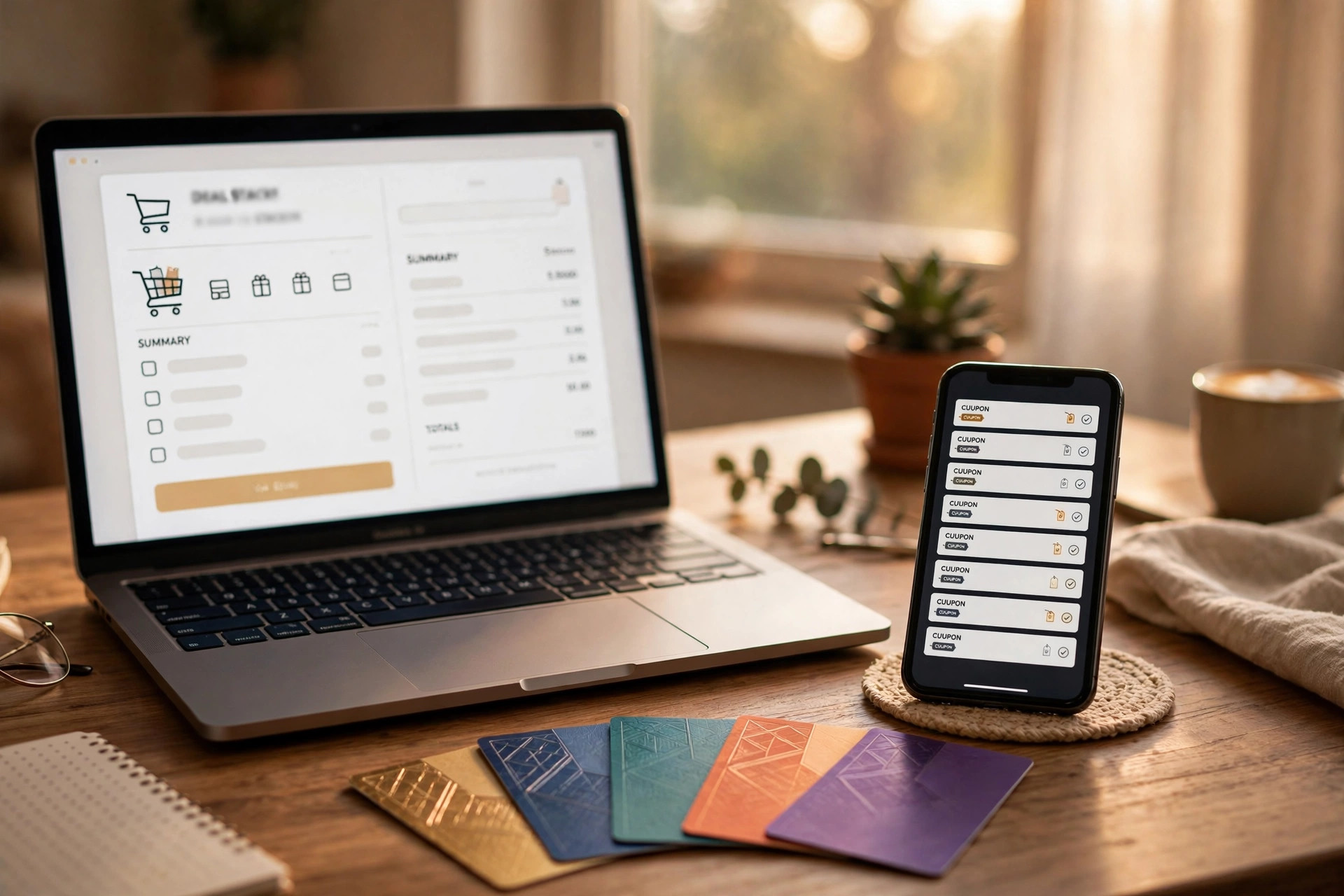
Sale price first — the stack multiplies a real discount, it does not create one. Then the coupon code at checkout. Then the cashback portal: start the session by clicking through it, because it pays on the post-coupon subtotal. Then pay with a store gift card you bought below face value. Then earn rewards points on the gift card purchase itself. Five layers, each ordinary, each real.
Order matters most at the coupon–portal junction. Cashback is computed on what you actually pay after coupons, so a 15% coupon slightly shrinks a 10% portal payout — and that is fine, because 10% of $170 beats 0% of $200. The costly mistake is clicking a coupon autofill extension after the portal click: the purchase gets credited to the extension instead. In my experience, one click path per purchase — portal or extension, never both.
Not every layer lands every time. No sale this week? The stack still works on full price. No coupon for this store? Cashback and the gift card carry it. Two or three layers is the typical outcome; on a planned holiday buy, all five. The habit that makes it automatic: portal account and discounted gift cards set up in October, coupon checked at checkout in November.
Coupons: the email signup is the real coupon
Skip the coupon-code aggregators — mostly expired codes and store-wide sales you already qualify for. The real coupon is the store’s own email signup: 10–15% off first orders, stacking with everything because it is the store’s own code. I keep a separate shopping email address; the code arrives in minutes and the noise never touches my real inbox. App-exclusive codes are the second-best source — retailers push in-app-only codes in November to buy app installs.
Browser-extension autofill is the useful modern version of the aggregator: it tests the known codes at checkout in seconds, and costs nothing to try on a store with no public codes. Just remember the portal rule above — extension and portal are rivals on the same purchase.
When a 20% code “suddenly” fails on the one item you wanted, read the exclusions. Gift cards, previous purchases, premium brands, and already-discounted items are routinely carved out — and a code that applies only to full-price items is worthless against a Black Friday markdown. I learned to check the exclusions before filling the cart, not after the disappointment.
Cashback portals: free money with click hygiene
Click through the portal before you shop, and the retailer pays it a referral commission it shares with you: 2–10% baseline, 15–25% promo spikes during holiday weeks. A 12% portal rate is effectively a 12%-off sale that also works on already-discounted items. Signups are free, payouts usually quarterly — it is the retailer’s marketing budget, not a points scheme.
Payouts fail for boring technical reasons, so click hygiene matters more than portal choice. Start the session fresh from the portal right before you buy — yesterday’s click will not survive the shopping. Disable ad blockers and privacy extensions for that tab, or shop in a clean browser profile. Complete the order in the same session. And never run an autofill extension on the same purchase — I lost a $40 payout that way, and it is the most common silent forfeit.
Portal versus store credit card is the one place to do the math: a 5%-everyday store card loses to a 10% portal rate in a promo week. My rule: portal for purchases, card rewards only for buying the gift cards — the one transaction the portal cannot track. Returns claw back cashback on returned items, so the payout is real only on what you keep.
Discounted gift cards: the easiest layer of the stack
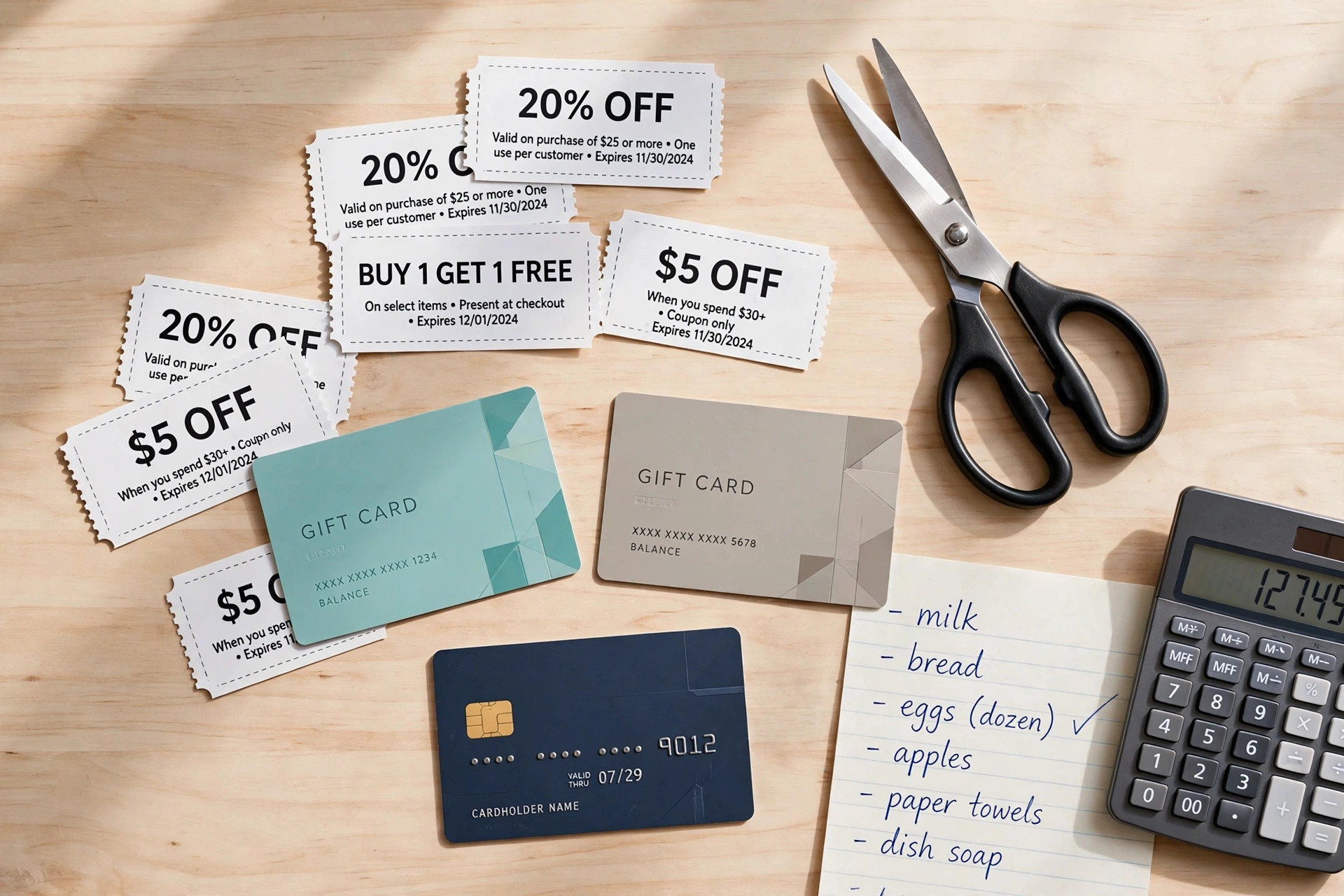
This layer has the best effort-to-savings ratio. Resale marketplaces sell store gift cards at 5–15% below face value — $92 for a $100 card — and because a gift card is just payment, it stacks with the sale, the coupon, and the cashback. On a $200 purchase, a card bought at 8% off is $16 of extra savings on work you did once, on your phone, in advance. Buy the cards in October; the good discounts thin out by December.
The scam line is bright and non-negotiable: established marketplaces with buyer guarantees only — never auction listings, social-media sellers, or absurd discounts (40%+ off a major store’s card is a stolen card). Never pay with crypto or a wire for a gift card. Check the balance on arrival and screenshot it. I buy only modest, boring discounts from high-volume sellers, and I have never been burned.
Two notes. Some portals do not pay on gift-card purchases — but the card’s discount usually beats the forgone cashback, so the card still wins the math. And do not buy gift cards at full price “for the rewards points”: 2% on a full-price card loses to buying the card itself at 10% off. The gift card is the discount; the rewards points are the garnish.
The traps and the worked math on $200
The full stack on a $200 item: sale 25% → $150. Email coupon 15% → $127.50. Portal 8% on the post-coupon subtotal → $10.20 back. Gift card bought at 8% off → about $10.20 of effective discount on the payment. Rewards on the gift card purchase, 2% → $2.55. Effective price: roughly $105 — a 48% saving from layers that were each individually ordinary. When I priced a real November purchase this way, the stack beat the doorbuster I was originally chasing.
The traps are the same three every year. Returns void the cashback — and a return on a gift-card purchase refunds back onto a gift card, which complicates everything; do not stack on anything you are unsure about keeping. Coupon exclusions quietly remove the brands you actually want. And ad-blocker-loaded browsers silently break portal tracking — the fix is a clean profile with the portal logged in and extensions off.
Know when to skip it. On a sub-$20 purchase, an 8% payout is $1.60 for five minutes of setup — take the coupon and move on. And on impulse buys the stack is a trap of its own: it makes a $40 gadget feel like $28, and neither price is a deal if you did not want it. The stack is for planned purchases — the gifts list, the replacement appliance, the thing you were buying in November anyway.
Frequently asked questions
Can I combine a coupon code with cashback?
Yes — it is the most reliable layer of the stack. Click through the cashback portal first, then apply the coupon at checkout. Portals pay on the post-coupon subtotal, so the coupon shrinks the payout slightly, but the combination still beats either trick alone. Skip the autofill extension on the same purchase — it can steal the portal’s credit.
Do discounted gift cards stack on sale prices?
Yes. A gift card is just payment, so it stacks with the sale, the coupon, and the cashback portal. Buy store gift cards at 5–15% below face value from established resale marketplaces, and the card discount becomes your discount on the whole order. Check the balance on arrival, and never buy from auction listings or sellers demanding crypto.
What kills a cashback claim?
The three usual killers: an ad blocker intercepting the click, starting at the portal yesterday instead of fresh today, and returns — cashback is clawed back on returned items. In-store pickup and price adjustments also commonly break tracking, so complete the order in one clean session and have it shipped for the cleanest payout.