
Black Friday 2026 Furniture & Home Decor Guide: Sofa Price Floors, the Delivery Trap, and Quality Tells
Furniture is Black Friday's most honest category and its most confusing. Discounts of 40–60% are normal — furniture margins are built for it — which makes November genuinely the best time to buy a sofa, a bed, or a dining set. But the "70% OFF" banners are pure theater. The real price to beat is the street price: I watched the sectional I eventually bought hold $1,899 for three straight months before November.
Here's what nobody tells you: the deal is decided after you buy. Delivery, assembly, lead times — I learned more from my second furniture delivery than from any price tag. This guide covers the price floors worth waiting for, the quality tells that separate a ten-year sofa from a two-year one, and the delivery fine print that ruins more "deals" than any fake discount.

Furniture pricing works differently — calibrate your expectations
Furniture is the one category where a 50% discount isn't exciting. The "was" prices are theater: nobody was ever going to pay $3,999 for that $1,899 sectional. The real game is the street price — what the piece sells for week in and week out — and Black Friday cuts that by 20–40%, which is where the genuine savings live.
Track the piece you want for two or three weeks before November. The November price should be meaningfully below the October price, not just below a list price that existed for a fortnight. Price-history tools are how you verify it — I check before every furniture purchase now, and it's saved me from more fake "sales" than anything else.
Watch the model-name shell game: the same sofa photo sold under five names at five prices, with different frames, foam, and fabric. Compare specifications — frame material, foam density, fabric type — not photos or model names.
Price tiers worth waiting for
Sofas and sectionals are the headline act. A decent 3-seat fabric sofa lands at $600–1,000 on Black Friday; a quality sectional with a chaise at $1,200–2,000. Below $500 for a full-size sofa, expect a particleboard frame and low-density foam — a two-year sofa, not a ten-year one. The jump from $800 to $1,400 usually buys a kiln-dried hardwood frame and 1.8 lb+ density foam, and that difference matters more than anything else on the spec sheet.
Bedroom furniture is the season's quiet star: upholstered platform beds drop to $250–450, solid-wood frames to $300–600. A 6-seat dining set hits $400–800 at the big online sellers. Home office runs strong too: sit-stand desks at $250–400, ergonomic task chairs at $150–300.
Rugs and lighting are where the percentages are actually real: an 8x10 rug that lists at $600 routinely sells for $180–280 in November, and lamps from design-forward brands hit 30–50% off. The margins were real, so the discounts are too.
The delivery trap and the assembly bill
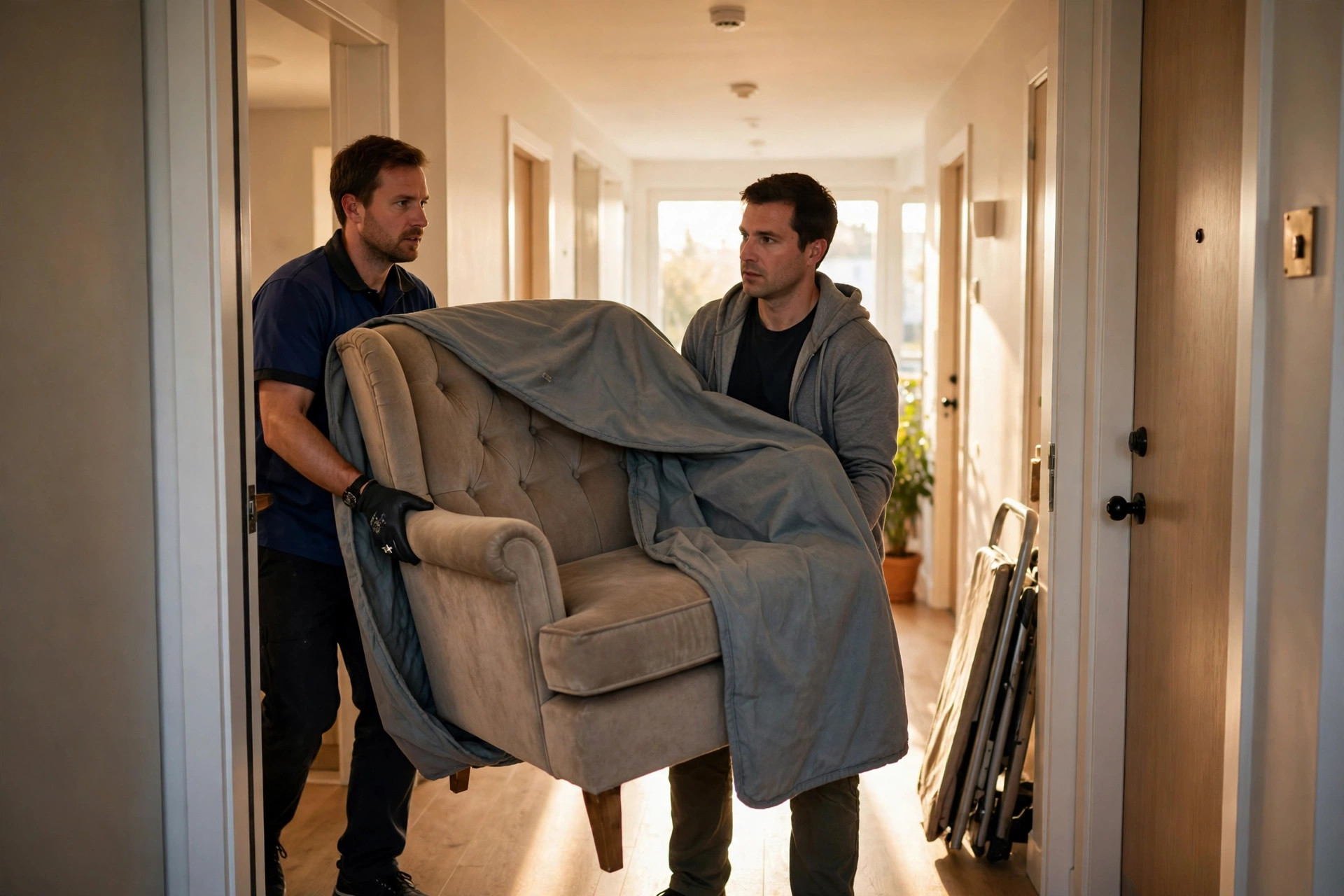
Furniture delivery isn't parcel shipping, and the fine print decides whether your deal arrives next week or next quarter. Free "threshold" delivery means the box lands at your front door or curb — for a 200-pound sectional, that isn't delivery at all. White-glove delivery (room of choice, assembly, packaging removal) typically adds $150–300, and for anything heavy or going up stairs, it's worth every cent.
Measure everything before you click buy: every doorway, every stairwell turn, every elevator door — plus the sofa's diagonal depth, the number that actually decides whether it turns a corner. I learned this the hard way: my first sectional wouldn't clear the stairwell landing, and the refused delivery turned into a three-week restocking fight.
Lead times are the hidden November tax. Popular pieces sell out and restock at 8–12 week lead times — order in late November and you're looking at a February sofa. Check the delivery estimate on the product page, not the sale end date, and if the piece you want shows a long lead time, buy during the early-November preview sales when stock is fullest.
Quality tells: the ten-year sofa vs the two-year sofa
The frame is the first tell. Kiln-dried hardwood lasts decades; "engineered wood" — particleboard or MDF — sags and strips its screws within a few years. Listings that hide the frame material are telling you it's not hardwood. Corner-blocked, glued-and-doweled joinery beats stapled frames.
The second tell is cushion construction: foam density of 1.8 lb per cubic foot or higher holds its shape; below that, cushions go flat in two years. Pocketed coils or a sinuous-spring base under the foam is a good sign. A listing that says only "high-density foam" without a number isn't telling you anything.
The third tell is the fabric: a rub count (Martindale) of 25,000+ survives daily use. "Bonded leather" is leather scraps glued to fabric and peels within a couple of years — only buy top-grain or genuine full-hide, and assume the rest is marketing. In my experience, removable washable covers are the sleeper feature worth paying a little extra for.
Timing: when furniture goes on sale
Early-November preview sales are the sweet spot: holiday pricing with full stock and normal lead times. The big sellers launch Black Friday prices two to three weeks early, and for big-ticket pieces, buying early means January delivery instead of March.
Black Friday week, November 27, is the price floor for the headline pieces — sofas, sectionals, bed frames — with the deepest extra-percentage-off codes and doorbuster pricing on rugs and decor. The constraint is stock: popular configurations sell through, so if you know the exact piece and fabric, don't wait for Cyber Monday.
Cyber Monday, November 30, favors small decor, lighting, and rugs: online-only extra codes on already-discounted items. After that, prices drift back up until the January white sales and Presidents' Day in February — the next real furniture sale. And don't sleep on floor models and open-box pieces at 40–70% off, or October's patio clearance at 50–70% off if you have storage space — both beat most November prices.
Frequently asked questions
Is Black Friday really the best time to buy furniture?
Yes — for indoor furniture, November is the year's deepest discount window. New collections land in spring, so retailers clear outgoing lines and run holiday events in November. Prices float back up in January and don't fall again until Memorial Day.
Why do identical-looking sofas cost so much more at some stores?
Because the brand and the factory are different things. Many sofas come from the same factories with different foam, frames, and fabric. Judge the build — kiln-dried hardwood frame, foam density, fabric rub count — not the product photo.
Should I pay for white-glove delivery on furniture?
For anything over about 150 pounds or that won't fit up your stairs, yes. Measure every doorway and stairwell turn before ordering — a refused delivery means a restocking fight and weeks of delay.